
At some point, almost every senior officer faces the same question. It arrives on a quiet afternoon somewhere between ports, with unusual clarity: what comes after this?
For most people with a decade or more at sea, the answer has a clear shape. The maritime industry stays with you. The knowledge is too specific, the network too valuable, the experience too hard-earned to leave behind. The real question is how to reshape that connection on your own terms.
What follows is written for officers and masters with serious sea time who are thinking carefully about what comes next. Specific answers to the questions that actually matter.
What Shore-Based Maritime Work Actually Looks Like
Independent marine surveyor. The most portable option for experienced officers and, over time, one of the most financially rewarding. Survey work covers condition surveys, pre-purchase surveys, on-hire and off-hire surveys, damage surveys, cargo surveys, and specialist investigations for P&I clubs and underwriters. You can be based anywhere with reasonable port access. The Atlantic corridor from Portugal to West Africa is particularly underserved by qualified independent surveyors. An open market for the right person.
Designated Person Ashore, marine superintendent, technical superintendent, HSEQ superintendent, Fleet Director. The employed shore track covers a broad spectrum of roles within shipmanagement companies and owners. Entry points — marine or HSEQ superintendent, DPA at a smaller operator — carry solid compensation and clear structure. Senior roles, Fleet Director or Group DPA at a major manager, carry genuine weight and scope. The ceiling in each position is fixed and the commercial pressures are real. For officers who prefer employment over independent practice, this is the most direct path. Competition for senior positions at reputable companies is meaningful.
Port captain and marine operations advisor. Providing expertise to port authorities, terminal operators, and project cargo handlers during complex operations. Strong day rates, specialist work, genuine operational application of sea experience. Requires established local relationships to get started. The right background opens doors quickly.
Independent maritime consultant and advisor. Working directly with shipowners, charterers, and operators on strategic and operational questions: fleet procurement, charter party review, operational risk assessment, casualty investigation, expert witness work. The highest-margin work in the independent sector, and the one that takes longest to build. Reputation is the product.
Maritime education and training. Academies and training organisations consistently need instructors with genuine operational backgrounds. Rarely a long-term financial strategy on its own. It builds visibility, keeps credentials current, and opens other doors. Worth holding alongside other work rather than treating as a primary income stream.
What Credentials You Actually Need
This question stops more people than it should. The credential landscape is real but manageable once you understand what clients actually look for.
For marine survey work, the credential that carries genuine weight with P&I clubs, underwriters, and serious commercial clients is membership of the International Institute of Marine Surveying. Full Membership (MIIMS) or Fellowship (FIIMS) requires demonstrating relevant sea or shore experience, passing a professional assessment, and maintaining continuing professional development. IIMS fellows also carry professional indemnity insurance. The application process is thorough. That is the point: it signals something real to the market.
Some class societies maintain lists of approved surveyors for specific purposes. If class-related surveys are part of your plan, understand the approval requirements early. They vary by society and by survey type.
For ISM and safety consulting, SQAS assessor certification is relevant for chemical tanker operators. For DPA roles, existing STCW certification combined with demonstrated shore experience is typically what employers assess.
The honest picture on credentials: they establish baseline credibility. Clients hire you because they trust your judgment on a specific problem. Credentials tell them you have met a minimum standard. Your track record and your reputation tell them whether to call you when something goes wrong at 0200.
The Income Reality: What Independent Practice Actually Pays
Most guides avoid this question. That avoidance serves no one making a serious decision.
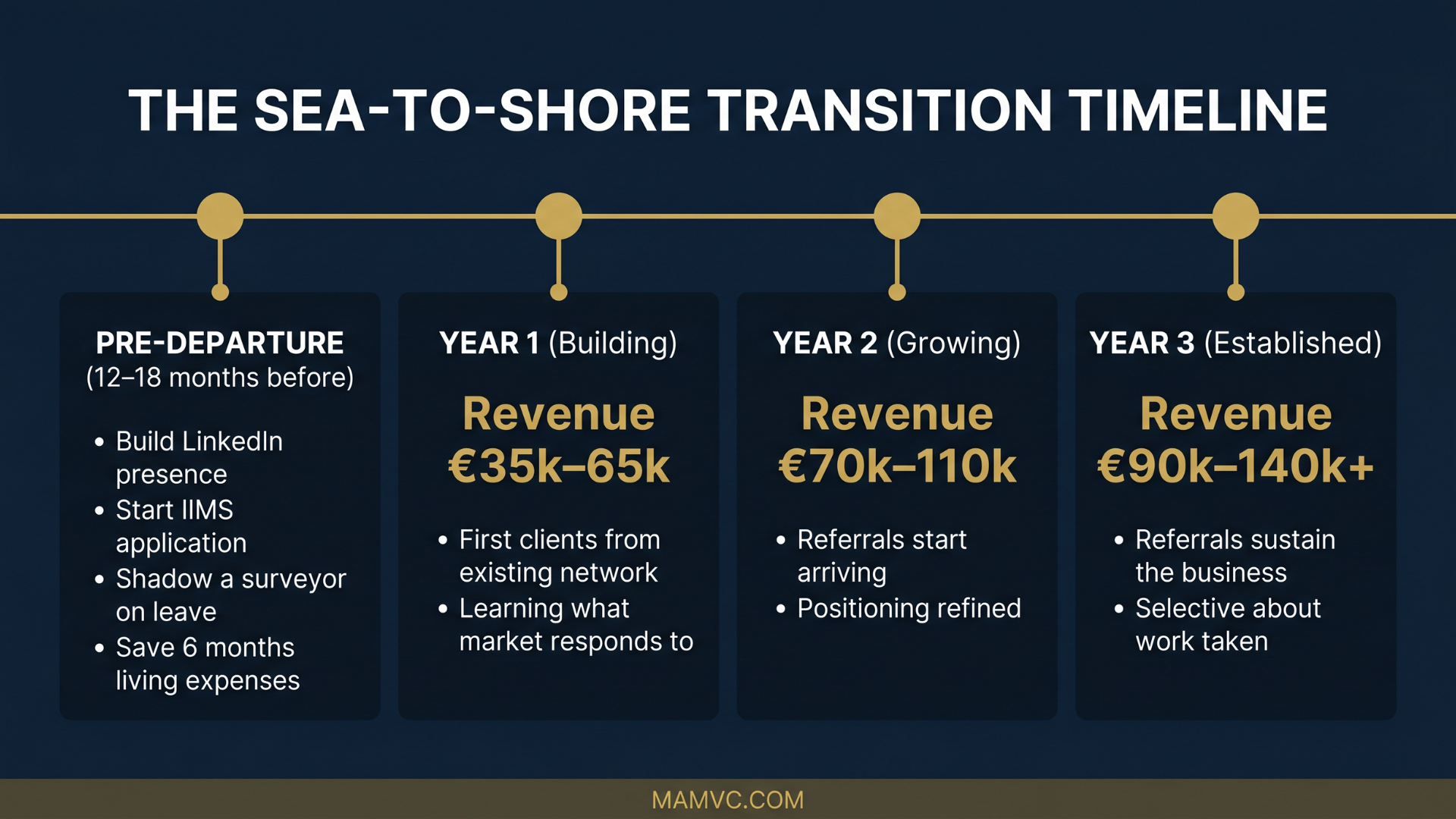
In the first year of independent survey practice, revenue between 35,000 and 65,000 euros is a realistic range for someone starting from scratch. This assumes active business development and genuine focus on building a pipeline, rather than waiting for the phone to ring.
By year three, with a developing reputation and referral base, 90,000 to 140,000 euros is achievable in the Atlantic European market. Experienced independent surveyors with established P&I club relationships and a recognised specialism regularly earn above this.
These figures need context. Your fixed costs as an independent operator are low: professional indemnity insurance (typically 2,500 to 5,000 euros annually), professional body fees, and travel, which is often partially recoverable from clients. The net margin on independent survey practice is high relative to most employed positions, and the trajectory improves consistently as your reputation compounds.
The comparison to seafaring income is more complicated than it first appears. Tax-free status, accommodation, food, and the structured certainty of a contract posting all have real value. Plan for an 18-month transition period during which income will likely sit below your last sea posting. Have six months of living expenses in reserve before you leave the vessel. If that reserve is beyond reach right now, use the time to build it alongside the network and credentials. The sequence matters.
The income ranges above are market reference data drawn from independent practitioners across the Atlantic European region. Individual figures will differ based on specialisation, geographic market, client relationships and consistency of business development effort.
How to Get Your First Client
New clients come from three sources: direct approaches, referrals, and visibility. In the early months, all three need to be active simultaneously.
Direct approaches work in maritime when they are specific and informed. A generic message to a P&I correspondent produces nothing. A specific note that says: I specialise in condition surveys for bulk carriers in the Atlantic corridor, I have handled this vessel type, and I have availability next month. That is a different conversation. Make it easy for people to understand exactly what you do and who you do it for.
Referrals are the most reliable long-term source of work. They come from doing good work and from being the person other professionals think of when a relevant question comes up. Build relationships with P&I club correspondents, maritime law firms, and ship brokers. Be useful to them. The referrals follow. This process takes time and cannot be rushed, but it compounds significantly from year two onwards.
Visibility means being present where your clients spend time. Write about what you know. One post per week on LinkedIn about a specific operational situation, a question you encounter frequently, or an observation from your survey work. Over 18 months of consistent output, this becomes a meaningful source of inbound enquiries. The key word is consistent. Sporadic effort produces sporadic results.
The first client almost always comes from someone who already knows you from sea or from a warm introduction. The second and third expand from there. Build the network before you need it, while you are still on the vessel.
The Hard Part Nobody Warns You About
It is identity, and it is the thing most officers are least prepared for.
At sea, authority is structural. You are the master. The hierarchy is clear and your competence is assumed within it. Your decisions carry weight because of your rank as much as because of your judgment. That structure provides a clarity that most people do not recognise they depend on until it disappears.
Ashore, authority is relational. You earn influence through demonstrated expertise and accumulated trust. Clients engage you because they believe your judgment is worth paying for. That belief takes time to build and it requires a different kind of presence than command at sea demands.
Many experienced officers find the first year ashore genuinely disorienting in ways that have nothing to do with practical challenges. They are competent. They have solved serious problems in difficult conditions. And they find themselves in a context where none of that is immediately visible. The transition requires patience that the sea rarely asked of them.
The antidote is to build visibility methodically and give yourself a realistic timeline. Almost every officer who makes this transition successfully and manages the financial runway correctly prefers the shore within three years. The work is challenging in different ways, the autonomy is real, and the relationship with family and home that sea service denied is finally available.
The Timeline: What the First Three Years Look Like
Year one is about establishing the infrastructure and landing the first clients. Revenue is below its eventual level. Business development takes more time than the actual work. You are learning what your market responds to and which types of engagements suit you. Evaluate the model at year three, never at year one.
Year two is where the pattern becomes clearer. Referrals begin arriving from early clients. Your positioning has been tested against the market and you have adjusted it. Revenue grows meaningfully. You begin to see which relationships are worth investing in and which types of work you want more of.
Year three is typically where independent practice becomes genuinely self-sustaining. Referrals account for most new business. You are no longer starting from zero with each client conversation. The compounding that makes independent practice so valuable over employed positions begins to show clearly in both income and the quality of work you are being asked to do.
This timeline assumes you start building before you leave the vessel. Officers who begin their network, credentials, and visibility work 12 to 18 months before their planned departure arrive ashore with real momentum. Officers who leave the sea and then begin building from scratch add at least a year to every stage.
When to Make the Move
There is no universally right time, but there are conditions that make a departure significantly more likely to succeed.
You are ready to transition when you have a clear income model for the first 18 months, the beginnings of a professional network ashore, the relevant credentials for your target work either completed or actively in progress, and at least one concrete conversation confirming there is real demand for what you offer.
If you are over 50, the case for moving sooner is stronger. Building a consulting reputation takes three to five years. The most financially rewarding and intellectually interesting work tends to come in years four through ten. Starting that clock earlier gives you more of the best years.
The question that matters is whether you are building the things that will make you ready. If the answer is yes and the financial runway is in place, the transition is a question of timing, and the timing is yours to set.
The Structured Path
I built my own practice from scratch after leaving command. I did it without a structured programme, which meant I learned certain things the slow and expensive way. The positioning mistakes that cost months. The pricing decisions that were too conservative early and required renegotiation later. The client relationships that stayed informal until they became complicated.
The Sea to Shore programme is the direct transfer of what I learned, offered as one-to-one mentorship to officers who are serious about making this transition work. We cover positioning, structure, client acquisition, and long-term practice building, specifically for the maritime professional context. Direct work. No group sessions, no recorded modules, no generic frameworks.
If you are at the point where this conversation is relevant, the first step is a 15-minute introductory call. If the programme is the wrong fit for where you are, I will say so directly.
The bridge was a chapter. What comes next is worth building properly.